






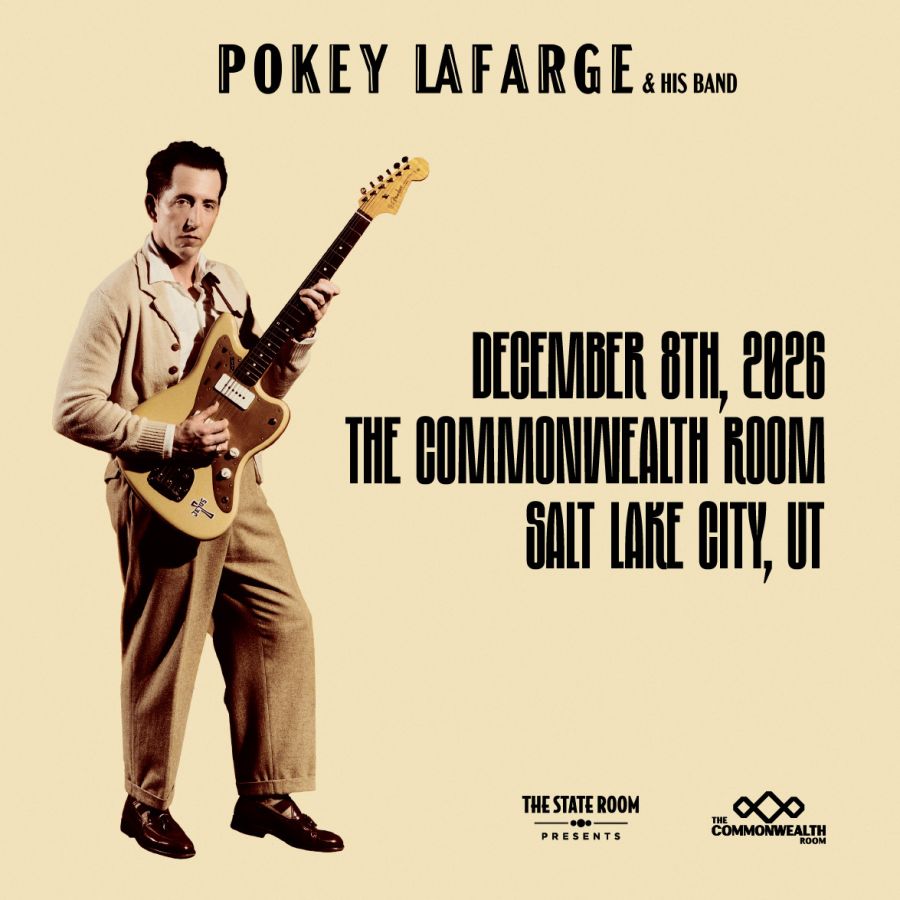
Pokey LaFarge
- Doors
- 7pm
- Show
- 8pm
- Ages
- 21+
Description
Pokey LaFarge
For two decades, Pokey LaFarge has walked his own effortlessly cool road as an exceptionally iconoclastic troubadour – forthright, genuine, and markedly keen to put it all out there. Rent Money now sees the Illinois native pushing forward yet again with what can safely be declared his finest collection to date, both as a heartfelt expression of personal experience and as no-nonsense social commentary. With their twanging guitars, plucky rhythms, and undeniably captivating melodies, songs like the instant classic album opener, “The Thing,” and the tub-thumping title track see LaFarge surveying kitchen-table issues and inter-class discontent, as well as his own fears, frustrations, and uneasiness about the future. “My Baby Loves Me” and the stunning soul dancefloor-filler “Stick Together” soar and swing, their joyous refrains belying the inescapable undercurrent of constant worry and angst that permeates these troubled times.
“I certainly want to sing pretty songs,” LaFarge says. “But I’m not impervious to the issues that are happening today in the world. There was so much talk while I was writing this record, about the economy and how everything is more expensive today than it was yesterday. How kids barely know their parents, because both parents have to work two jobs. Just the absurdity of it all. It really does make you, I don’t want to say angry, but it makes you want to play music that’s a little bit tougher.”
As always, LaFarge deftly traverses genre boundaries, seamlessly integrating the myriad strains of 20th-century American music with a freewheeling command of earnest songcraft, inspired performance, and subversive creativity. 2024’s Rhumba Country blasted his sonic palette open with hints of island rhythms, highlife guitars, and more, maximizing those sounds by exploring them in his own unique fashion. Produced once again by Elliot Bergman (Wild Belle, LA LOM, Natalie Bergman), Rent Money now builds upon that record’s sweeping approach with an even wider panoply of influences, spanning – but limited to – urban blues, primal rock ‘n roll, early jazz, ragtime, first wave reggae, boogie, gospel and electric country funk, all brewed up into an irresistible honky-tonk of sound that somehow encompasses all the aforementioned styles but ultimately becomes something utterly original.
“Every record is a springboard into some new direction,” says LaFarge. “Maybe it’s going back, sometimes it’s going lateral, sometimes going exponentially forward. I’ve tried a lot of different stuff on the last few records. For me, this one was about sort of trimming the fat – super simple, less chords, less movement, just kind of getting back to my roots, just remembering where I came from and the music I started listening to when I first came up. I wanted to get back to some of the childlike simplicity I had when I first heard Chicago blues. Guys like Howlin’ Wolf and Chuck Berry changed my life.”
Working over a series of sessions at the producer’s “big, beautiful studio” in the rural woods just outside of Chicago, LaFarge and Bergman keep the arrangements crisp and uncluttered so that every nuance of instrument and voice can be clearly heard, utilizing the studio’s ample space, as well as a variety of vintage amps and equipment, to get a warm, cinematic, sound more expansive and resonant than on any of his previous work. Much of the album was crafted in spontaneous first takes, with LaFarge laying down basic grooves and licks which were then embellished and augmented by the multi-talented Bergman and an assortment of trusted band members, with extra color courtesy of backing vocals from his wife and frequent co-writer – Addie Hamilton, and Bergman’s sister, acclaimed singer-songwriter Natalie Bergman.
“I don’t know much about studio stuff,” LaFarge says. “I just know what I want the song to sound like. I’m always just thinking about the song and the performance, and then hopefully the people that are in the studio with me can make it work. That’s why finding the right producer matters, somebody who really is going to let you be yourself, not try to project. I’ve had that in the past – sometimes it worked and really pushed boundaries for me and helped me kind of till some new soil, and other times it’s been kind of a square peg in a round hole-type situation. It just hasn’t worked out. You take some chances, and you make some mistakes. But in this case, Elliot definitely knows who I am for the most part and is able to kind of heighten that in the studio.”
Though in many ways LaFarge’s most explicit record as far as conveying his social conscience, Rent Money doesn’t lay blame or point fingers. The only side LaFarge chooses to take in this unceasingly divided era is that of the common man, opting not to declare either himself red or blue by speaking to values and experiences that are – or at least should be – universal. LaFarge believes his purpose as an artist is not to get between factions with different beliefs, but to heal the wounds between them with the righteous power of rock ‘n’ roll, however one defines that all-encompassing music.
“My perspective with most things, whether they be social issues, maybe quasi-political issues, I very rarely choose to be overt,” LaFarge says. “That’s the antithesis of poetry for me. I would rather be a little bit more subversive and, like the artist MC Escher, create a different perspective. Planting seeds and saying things in a different way that hopefully allows people to look at things from a different light.”
Despite their exuberant spirit, songs like “Work” and “Big Boss Man” – not the Jimmy Reed standard but a self-penned new original – survey how hard work in hard times doesn’t always pay the bills, both in terms of practicality and spiritual sustenance. LaFarge artfully avoids direct polemic to better explore the effects of politics on living, breathing people, giving his songs a pragmatic power to strike a universal chord in a divided audience that, in its heart, still yearns for community and connection.
“I’m not making any accusatory statements,” he says. “I’m trying to get at the truth of who we are in America today. Things like pursuit of wealth and comfort and convenience, they’re things that have maybe always been there, but now it’s more so. They’re just sort of heightened. And how those things have become more important than culture, integrity, family, and things of that nature. You know, I never wanted to just underline things, or more specifically, make blanket statements in my records. We’re all a part of this thing called America, and my idea is to just kind of talk about things in a poetic way. That’s the best way to sing. That’s how we started singing in the first place. We sing poems.”
Now happily ensconced in bucolic Maine with Hamilton and their brand new bouncing baby daughter, LaFarge takes an equally down-to-earth view towards more personal matters on such songs as the road-weary, gospel-inflected “Stranger” and the border radio swoon of “Told You No.” Unafraid – in his music, on stage, or in conversation – to wear his heart on his sleeve, he casts his eye towards the past, having spent more than half of his time on God’s green as a hard-traveling musician.
“Looking back at my career, I’ve dealt with a lot of rejection,” LaFarge says. “I chose not to play pop music, and one can’t have regrets. I mean, I’ve made it. I’ve made a living for 20 years playing music, but, man, it can be hard. It hasn’t been an easy path. I’m sort of out there plowing my own field. I’ll continue writing songs, but who knows, maybe I’ll pick up the fiddle and start learning old-time fiddle songs. Or maybe I’ll do something completely different and start playing French Canadian music - I’m only four hours away here in Maine.”
While LaFarge is adamant about not taking a public stance, there’s no doubt he views Rent Money as a rare opportunity to engage his audience in a frank conversation about what unites us despite vast differences in opinion and belief, and looks forward to hitting the road for the chance to give these powerful, populist songs a chance to fulfill their mission. Rent Money stands tall as an indisputable high-water mark for Pokey LaFarge – a defining collection from a one-of-a-kind artist of rare ingenuity and uncommon candor, now as ever, determinedly crafting a sure-footed brand of deeply human music all his own.
“People are always going to tell you what they think you should play,” says Pokey LaFarge, “what you should sing about, how you should sound, how you should look, how you should act. And I’ve always just been like, nah. Nope. I’ve just completely gone my own way, and hopefully I’ve been honest and authentic in the process.
“I’m just trying to make music that AI can’t replicate. Things are so homogenized right now. That’s what I’m really, really, really resistant to, especially when it comes to music. I’m not going to do it. I’m not going to conform.”
Cicada Rhythm
"Cicadas have long been a mysterious phenomenon in the American South, living for long years under the soil before emerging simultaneously, seemingly without warning, to fill the long, drooping summer days with their vibrating song.
It’s fitting, then, that Cicada Rhythm has been on a hiatus of sorts, gathering its strength underground, emerging with a new record after nearly seven years.
Andrea DeMarcus, a Juilliard trained bassist, and Dave Kirslis, a train-hopping guitarist, met in 2011 after the freight train Kirslis had been hitching a ride on stopped in Athens. What began to develop then were the seeds of both a romantic and musical relationship, a conversation over the next 14 years which would lead to marriage, roots in the community and two critically lauded albums.
2015’s self-titled album was in many ways a success; the duo’s foot-stomping rhythms, electrifying harmonies and open road sensibilities perfectly captured the roots revival movement of the early 2010s, drawing the early attention of peers such as The Wood Brothers, Houndmouth and The Milk Carton Kids. But to the members of Cicada Rhythm, their sound wasn’t merely a trend. It was fundamental to the way they expressed themselves musically, an organic result of their experiences in both American cities and the natural world.
2018’s Everywhere I Go expanded on the group’s trademark sound, working with local drummer Colin Agnew and penning songs of the open road that were at times poignantly political in nature.
When the 2020 COVID pandemic swept across the globe, effectively halting the livelihoods of thousands of career musicians, DeMarcus and Kirslis were forced to re-evaluate their priorities as musicians. Kirslis found solace in the trades, becoming a carpenter with Athens’ Levelish Construction. Carpentry gave him a skill that could be measured, where each movement was a clear step towards a finished product.
DeMarcus said that by not leaning as much on music as a main source of income, her relationship with music became deeper. No longer pressured to constantly churn out music, meet arbitrary deadlines or create promotional content, she and Kirslis became more discerning with the shows they played, and found greater joy in the act of simply making music with others.
“Music became more of an outlet,” De Marcus said. “We started to have more gratitude on stage.”
The couple also began work in 2020 on a full renovation of an abandoned farmhouse from the 1800s, a project which put Kirslis’ carpentry skills to the ultimate test. DeMarcus and Kirslis moved in this summer. The home and the surrounding land will be the location of the seventh annual Cicada Rhythm farm show, a now legendary tradition that celebrates the community and the healing power of music.
This year’s show will also serve as a release show for their upcoming album. After focusing mainly on carpentry for so long, and at risk of “turning into a two-by-four,” Kirslis began to think about releasing music again.
“I wanted to be an artist,” he said. “That’s who I am. At the end of the day, what I’m most proud of is this music and this band.”
The duo had been hard at work behind the scenes, with a vast back catalog of unreleased music that had gradually been forming itself into a cohesive album. The result, this year’s Magic State, is a 12-track record that, while retaining the group’s signature sound, is wondering and curious. Whereas Cicada Rhythm’s earlier records stand quite firm in their statements, Magic State is more nebulous. It’s an album that reflects life in transition, the infinite possibility, the magic state of change.
“The album is about questioning truths you once thought were concrete,” DeMarcus said. “There aren’t many conclusions to be made; it’s all questions.”
The record begins with the song “Oranges and Cream,” an infinitely tender love song by DeMarcus. Crunchy guitar carries the rapturous chorus, which builds with anticipatory flourishes until it releases like a warm sigh.
The second track, “Quick Buck,” was inspired by Kirslis’ affinity for scrapping, a hobby he took up during COVID. While working as a contractor, he would frequently collect scrap from job sites that would otherwise be thrown away. “When we’d throw away fan motors or a little bit of wire or pipe, I’d grab it because it’s like a little piggy bank to me,” said Kirslis.
One day, Kirslis and his friend Matthew Pendrick, an Atlanta musician, took a trip to Athens Recycling with notepads in hand and wrote down what they saw. From the menagerie of items came a song that is equal parts playful and rugged, about a man down on his luck looking to sell his scrap.
The record was recorded over a five day period at Agnew’s home studio in Madison, and it is being released independent of any label. The album art was created by Flournoy Holmes, an artist whose work includes the iconic cover for the Allman Brothers’ album Eat A Peach, as well as work for Carole King, Dr. John and Kansas. - (description written by Patrick Barry) - Athens Flagpole
THE STATE ROOM
638 South State Street
Salt Lake City, Utah 84111
800-501-2885
Box@TSRPresents.com
THE COMMONWEALTH ROOM
195 West 2100 South
South Salt Lake, Utah 84115
800-501-2885
Box@TSRPresents.com
THE STATE ROOM PRESENTS
DEER VALLEY
LIVE AT THE ECCLES
FORT DESOLATION
OTHER ROOMS
Tickets online at AXS.comIn person at Graywhale
Box office open show nights
Are you in a local band and want to play one of our venues?
Fill out this form to be added to our local support pool!